
Cucumber diagnostic guide
Cucumber Pests & Diseases. How to identify the problem
White powder, angular yellow spots, a suddenly wilted vine, sticky leaves, stippling, and chewing damage can all show up on cucumbers. They do not point to the same cause. This guide helps you read the pattern first, find the pest or disease branch, and choose the next step with less guesswork.

Start here
What causes cucumber problems?
Cucumber problems are easiest to diagnose when we combine what the symptom looks like with where it appears, how fast it changes, and what is happening underneath the leaf.
Powdery mildew creates white surface growth. Downy mildew produces yellow angular lesions that are boxed in by leaf veins. Aphids and whiteflies leave honeydew. Spider mites stipple the leaf from underneath. Cucumber beetles chew holes and can transmit bacterial wilt. Wilt can also come from heat, dry soil, damaged roots, saturated roots, or stem injury, so reaching for the watering can before checking the whole plant can make the diagnosis harder.
Cornell CALS greenhouse trials reported 96% +/- efficacy against powdery mildew with the strongest results tied to repeat applications and complete plant coverage.
For cucumbers, the first job is separating an active surface problem such as powdery mildew or a supported soft bodied pest from problems that need a different response, including downy mildew, bacterial wilt, viruses, cucumber beetles, root stress, and irrigation trouble.
Cucumber problem finder
What do you see?
Choose the closest match. The result tells you what to inspect next, which branch is most likely, and whether Lost Coast Plant Therapy belongs in that branch.
Compare quickly
Cucumber symptom comparison matrix.
Use this desktop view when several symptoms overlap. On mobile, the Problem Finder above replaces the table.
| Symptom | Where it starts | Likely branch | What to inspect next | Can Lost Coast Plant Therapy help? | Deeper guide |
|---|---|---|---|---|---|
| White powdery growth | Often older leaves first, then more foliage | Powdery mildew | Surface growth on both leaf sides; diffuse patches | Yes | Powdery Mildew → |
| Angular yellow lesions | Leaves, often expanding quickly in humid weather | Downy mildew or angular leaf spot | Gray-purple underside growth; water-soaked tissue | Different approach | Mildew comparison → |
| Sticky leaves | Below feeding colonies | Aphids or whiteflies | Colonies, nymphs, flying adults, ants, sooty mold | Yes, after pest confirmation | Pest profiles → |
| Fine stippling or bronzing | Leaves, often hot protected areas | Spider mites | Leaf undersides, moving specks, fine webbing | Yes | Spider Mites → |
| Jagged holes or flower chewing | Young leaves, flowers, fruit | Cucumber beetles or chewing insects | Yellow beetles with black stripes or spots | Different approach | Cucumber beetles → |
| Whole-vine wilt | One section or vine, then more plant | Bacterial wilt, root stress, heat, stem injury | Beetles, soil moisture, roots, stem base, recovery at night | Only for a separate supported pest | Wilt diagnosis → |
| Mottled or distorted leaves | Often new growth | Virus, aphids, nutrient or root stress | Aphids, fruit distortion, pattern on new leaves | Depends on confirmed pest | Leaf patterns → |
The cucumber mildew check
Powdery mildew vs. downy mildew.
These two names sound similar, but the leaf tells two different stories. Powdery mildew is mainly a surface-growth problem. Downy mildew produces angular lesions inside the leaf tissue and usually shows its spore growth underneath during wet or humid conditions.

Surface growth
Powdery mildew
White powdery spots can form on upper and lower leaf surfaces and expand into larger patches.
Appearance
White, powdery, fuzzy-looking surface colonies that may merge.
Where
Usually visible on the leaf surface, often starting on older foliage and expanding through the canopy.
Surface vs tissue
The white growth sits on the surface rather than forming a vein-bounded yellow lesion inside the leaf.
Shape
Diffuse spots and blotches rather than neat vein-bounded angles.
Conditions
Warm conditions can support spore production and spread even without prolonged leaf wetness.
Progression
Older leaves may show it first, then more canopy becomes coated and leaves yellow or decline.
Inspect next
Check whether the white material is growing on the surface and appears on more than one leaf.
Direction
Improve airflow and drying. Lost Coast Plant Therapy fits when active powdery mildew is confirmed.

Tissue lesions
Downy mildew
Pale green to yellow lesions form between veins and become sharply angular on cucumber leaves.
Appearance
Yellow or pale green tissue spots above; gray to purplish growth underneath when humidity is high.
Where
Lesions show in the upper leaf tissue while the spore growth is most diagnostic on the underside.
Surface vs tissue
The yellow lesion is part of the leaf tissue; the underside growth appears with humid conditions rather than as a white coating across the top.
Shape
Angular lesions boxed in by leaf veins are one of the strongest cucumber clues.
Conditions
Wet leaves and very humid weather strongly favor infection and rapid spread.
Progression
Lesions can merge quickly and whole leaves may turn brown as if scorched or frost-damaged.
Inspect next
Turn the leaf over early in the morning or during humid conditions and inspect the lesion underside.
Direction
Use downy-mildew-specific local guidance, resistant varieties where available, and labeled disease-management tools.
One more lookalike matters: angular leaf spot can also produce vein-bounded cucumber lesions. If the spots look wet or translucent instead of showing the classic dark underside growth of downy mildew, keep a bacterial leaf-spot diagnosis in the running.
Cornell CALS greenhouse trial
Cornell tested active powdery mildew.
Independent greenhouse trials conducted by Cornell University’s College of Agriculture and Life Sciences evaluated Lost Coast Plant Therapy against established powdery mildew on tomato, melon, and hemp. The highest mean efficacy reported on the dedicated trial page was 96% +/- against powdery mildew. Each trial used five applications, and Cornell reports that repeat treatment and complete plant coverage produced the strongest results.

Look under the leaves
Common cucumber pests.
Aphids, spider mites, and whiteflies can all live underneath cucumber foliage, but their damage and behavior are different enough to separate with a careful inspection.

Sticky leaves • curled growth • colonies
Aphids
Aphids gather on tender cucumber growth and leaf undersides. Their colonies can distort young leaves and leave sticky honeydew behind. Ants moving up the vine often lead directly to the feeding site. Melon aphids may also transmit plant viruses, so the presence of aphids and mottled new growth deserves a closer look.

Stippling • bronzing • hot dry pressure
Spider mites
Spider mite damage often shows from above before the mites are easy to see. Fine pale dots build into a dusty or bronzed look, especially during hot dry weather or in protected production. Turn several leaves over, use magnification, and look along veins for tiny moving specks and eggs. Fine webbing usually means the population has already built.

Flying adults • nymphs underneath • honeydew
Whiteflies
Brush a cucumber leaf gently. A small cloud of white insects that lifts and settles again is a strong whitefly clue. The adults are easy to notice once disturbed, while eggs and nymphs stay on the underside and can be missed. Heavy populations can yellow leaves, produce honeydew, and support black sooty mold.

Silver scarring • black specks • sheltered tissue
Thrips and other small pests
Thrips are not always the first cucumber pest noticed, but they can scar leaves, flowers, and tender tissue. Their narrow bodies hide in folds and blossoms. Silver streaking with tiny black specks is more suggestive of thrips than the even stippling produced by spider mites. Leafminers and other small pests create different patterns and should be identified before treatment.
Diagnosed powdery mildew or a soft bodied pest?
Lost Coast Plant Therapy controls supported pests and powdery mildew on contact. Thorough coverage matters, especially on cucumber leaf undersides, folds and stems.
A different control branch
Cucumber beetles can chew and spread wilt.


Cucumber beetles chew leaves, flowers, stems, and developing fruit. That visible feeding already puts them in a different branch from aphids, whiteflies, and mites. Their bigger diagnostic importance is bacterial wilt. Striped cucumber beetles are especially important carriers of the bacteria that cause wilt, and spotted cucumber beetles can also transmit it.
A cucumber vine that suddenly wilts after beetles have been active deserves more than another drink of water. Bacterial wilt can begin with leaves that wilt during the day and recover at night, then progress until a section or entire vine stays wilted. Once the plant is infected, spraying the wilted tissue does not cure the bacterial disease.
Chewing clue
Fresh jagged holes, flower feeding, or scars on fruit point toward a chewing insect.
Beetle clue
Look for yellow adults marked with black stripes or spots, especially on young growth and flowers.
Wilt clue
Beetle activity plus a wilt that keeps progressing raises the bacterial wilt concern.
A wilted vine needs context
Why is my cucumber wilting?
Direct answer
Cucumber wilt can come from heat, dry soil, damaged or saturated roots, bacterial wilt, stem injury, or severe disease. Check the root zone and the whole vine before deciding that more water is the answer.
Heat or dry soil
Leaves may droop during the hottest part of the day and recover as temperatures fall. Check moisture several inches down instead of judging only the surface.
Root saturation or damage
A wet root zone can also produce wilt because stressed roots stop moving water normally. Look for slow drying, damaged roots, and poor drainage.
Bacterial wilt
Wilt that progresses along the vine, especially where cucumber beetles are present, needs a bacterial wilt check. Infected plants do not recover from a foliar spray.
Stem or vine injury
A kinked, split, bored, or damaged stem can interrupt water movement. Follow the wilted section back toward the crown and inspect the vine itself.
Read the leaf before naming the disease
Cucumber spots and color patterns.
Cucumber diseases are easier to route when the symptom is described precisely. These six patterns answer more than “the leaf is yellow.”
Powdery surface growth
White growth sitting on the surface strongly favors powdery mildew, especially when patches expand and remain visible in dry weather.
Angular lesions
Yellow or brown patches with straight vein-bounded edges point toward downy mildew or angular leaf spot. Turn the leaf over next.
General yellowing
Even yellowing can come from older leaf age, root stress, nutrient limits, sap-feeding pests, or a disease that has already reduced leaf function.
Mottling and mosaic
Irregular green-and-yellow mottling, puckering, rings, and distorted growth raise a virus question. Check new leaves and fruit shape.
Wet-looking lesions
Translucent or water-soaked tissue points toward bacterial or water-mold disease branches rather than a dry surface residue.
Lower-leaf progression
When older leaves decline first, compare surface growth, spot shape, splash history, and whether new leaves remain clean before assuming the whole vine is infected.
Conditions change the odds
What makes cucumber problems spread faster?
Disease pressure and pest pressure do not build the same way. These conditions tell you which problem is gaining an advantage.
Wet foliage and high humidity strongly favor downy mildew and several bacterial or leaf-spot problems.
Crowded vines dry slowly and make it harder to inspect leaf undersides before pests or mildew expand.
Heat and drought stress cucumbers and give spider mites an especially favorable environment.
Protected spaces can hold humidity while also allowing aphids, whiteflies, thrips, and mites to build without rain or cold interruptions.
Repeatedly wetting foliage can extend the wet period that several leaf diseases need. Watering at the root zone also makes symptoms easier to interpret.
Cucumber vines grow fast. A five-minute underside inspection twice a week can catch colonies, stippling, and new lesions while they are still localized.
Once the branch makes sense
What to do after diagnosis.
Confirm a live problem
Look for active insects, fresh lesions, spreading surface growth, or new wilt. Old damage can remain after the cause has changed.
Remove the pressure you can control
Correct leaf wetness, airflow, irrigation, severe crowding, or heavily damaged material when those conditions are part of the diagnosis.
Use the right treatment branch
Powdery mildew and supported soft bodied pests can move into the Lost Coast Plant Therapy branch. Downy mildew, cucumber beetles, viruses, and bacterial wilt need other tools.
Watch new growth
Judge progress by fresh leaves, live pest numbers, and whether new lesions are still appearing. Damaged tissue usually stays damaged.
Build a cucumber application routine.
Once you have confirmed powdery mildew or a soft bodied pest, the routine starts with reaching the target. Lost Coast Plant Therapy controls supported pests and powdery mildew on contact, so complete saturation and careful coverage matter.
Read the Instructions page for mixing and repeat applications. On cucumbers, pay special attention to upper and lower leaf surfaces, folds, stems, active mildew patches, and the sheltered places where small pests feed.

Application
routine
Best fit
Confirmed active powdery mildew or a supported soft bodied pest such as aphids, spider mites, whiteflies, or thrips.
Before you spray
Confirm a live target. Old damage, wilt, or yellowing by itself is not enough to choose a treatment.
Application
Use Lost Coast Plant Therapy as directed by the current label and Instructions page. Complete saturation is the goal.
Coverage
Coat leaf tops, leaf undersides, folds, stems, active mildew surfaces, and sheltered pest feeding sites.
Repeat applications
Repeat as needed according to the current label, pest pressure, and disease pressure. Cornell’s powdery mildew results were strongest with repeat treatment and complete coverage.
Powdery mildew
Reach the active white surface growth on both sides of affected cucumber leaves.
Soft bodied pests
For aphids, spider mites, whiteflies, and thrips, direct contact at the hiding place is essential.
Use another plan
Downy mildew, cucumber beetles, bacterial wilt, viruses, root stress, irrigation trouble, and nutrient problems need another management direction.
Where Lost Coast Plant Therapy fits.
On cucumber plants, the strongest fit is a confirmed case of powdery mildew or a supported soft bodied pest such as aphids, spider mites, whiteflies, or thrips.
Our product works by contact, so coverage decides whether the target is actually reached. On cucumbers that means coating active mildew surfaces, leaf undersides, folds, stems, and the sheltered spots where small pests feed. Current instructions emphasize complete saturation and repeat applications as needed.
Downy mildew, cucumber beetles, bacterial wilt, viral disease, nutrient issues, irrigation problems, and root damage belong in other management branches.

Cucumber pest & disease

What are the most common cucumber diseases? +
Common cucumber disease problems include powdery mildew, downy mildew, angular leaf spot, bacterial wilt, anthracnose, viral diseases, and several leaf-spot or blight problems. The pattern matters more than the disease name at first. White surface growth points toward powdery mildew, vein-bounded yellow lesions raise downy mildew or angular leaf spot, and whole-vine wilt needs a separate root, water, heat, and bacterial-wilt check.
What pests attack cucumber plants? +
Cucumber plants are commonly attacked by aphids, spider mites, whiteflies, cucumber beetles, thrips, leafminers, and several chewing insects. Aphids and whiteflies leave honeydew, spider mites cause fine stippling and bronzing, while cucumber beetles chew visible holes and can spread bacterial wilt.
Is the white powder on my cucumber powdery mildew? +
White powdery growth that sits on the leaf surface in expanding patches is strongly consistent with powdery mildew. Check both upper and lower leaf surfaces and compare the texture with normal leaf markings or residue. Downy mildew looks different: its upper-leaf lesions are usually yellow and angular, while dark gray or purplish growth appears underneath during humid conditions.
How can I tell powdery mildew from downy mildew on cucumbers? +
Powdery mildew produces diffuse white powdery growth on leaf surfaces. Downy mildew produces pale green to yellow angular lesions bounded by veins, with gray to purplish growth on the underside in humid conditions. Powdery mildew can spread during warm, relatively dry weather, while downy mildew depends on wet or very humid conditions and can move through cucumber foliage quickly.
Why are cucumber leaves turning yellow in patches? +
Patchy yellowing can come from downy mildew, angular leaf spot, spider mite feeding, viruses, nutrient problems, root stress, or ordinary aging of older leaves. Vein-bounded angular lesions point toward downy mildew or angular leaf spot. Fine pale stippling suggests mites. Irregular green-and-yellow mottling or distorted new growth raises a virus or stress question.
Why is my cucumber wilting? +
Cucumber wilt can come from heat and dry soil, damaged or saturated roots, bacterial wilt, stem injury, or severe disease pressure. Bacterial wilt often progresses along the vine and is strongly associated with cucumber beetle activity. Check soil moisture, the stem base, root-zone condition, beetle presence, and whether the plant recovers when temperatures cool before adding more water.
What tiny bugs are under cucumber leaves? +
Tiny insects or moving specks under cucumber leaves are often aphids, whitefly nymphs, spider mites, or thrips. Aphids form visible colonies and produce honeydew. Whitefly adults fly when leaves are disturbed while nymphs stay attached underneath. Spider mites look like tiny moving dots and cause stippling or bronzing.
Can spider mites attack cucumbers? +
Yes. Spider mites can build quickly on cucumbers, especially during hot, dry weather or in protected growing spaces. Early damage appears as fine pale stippling. As pressure increases, leaves can bronze, dry, and develop fine webbing. Inspect leaf undersides with magnification before treating.
Do cucumber beetles spread disease? +
Yes. Striped and spotted cucumber beetles chew cucumber leaves, flowers, stems, and fruit, and they can carry the bacteria that cause bacterial wilt. Striped cucumber beetles are especially important vectors. Once a plant is infected with bacterial wilt, spraying the wilted plant does not cure the bacterial disease, so beetle management and early diagnosis matter.
Which cucumber problems can Lost Coast Plant Therapy help control? +
Lost Coast Plant Therapy fits cucumber problems when the diagnosis is active powdery mildew or a supported soft bodied pest such as aphids, spider mites, whiteflies, or thrips. It controls supported pests and powdery mildew on contact, so complete coverage matters.
Sources and further reading.
Independent horticultural guidance
Official product information
University of Minnesota Extension on cucurbit powdery mildew
for white powdery growth, leaf-surface symptoms, warm dry spread, airflow, and cucumber disease pressure.
→
University of Minnesota Extension on cucurbit downy mildew
for vein-bounded angular lesions, underside fuzz, wet and humid conditions, rapid progression, and cucumber susceptibility.
→
University of Maryland Extension key to cucumber problems
for cucumber beetles, jagged feeding, bacterial wilt clues, and broad cucumber diagnosis.
→
University of Maryland Extension on cucumber beetles
for striped and spotted beetle identification, feeding injury, and crop scouting.
→
University of Minnesota Extension on bacterial wilt
for cucumber beetle transmission, wilt progression, and why treating an infected plant does not cure the disease.
→
UC Statewide IPM cucumber guide
for cucumber pests and diseases including aphids, spider mites, whiteflies, cucumber beetles, powdery mildew, and downy mildew.
→
Cornell Vegetables on cucurbit downy mildew
for cucumber downy mildew diagnosis and comparison with powdery mildew.
→
Lost Coast Plant Therapy Cornell University Trial Results
for the current 96% +/- powdery mildew result, five-application trial design, and the importance of thorough coverage.
→
Lost Coast Plant Therapy Powdery Mildew Guide
for current powdery mildew product scope and application guidance.
→
Lost Coast Plant Therapy Aphids Guide
for aphid identification and current contact-control guidance.
→
Lost Coast Plant Therapy Spider Mite Guide
for stippling, bronzing, webbing, and leaf-underside coverage.
→
Lost Coast Plant Therapy Whitefly Guide
for whitefly identification and current product information.
→
Lost Coast Plant Therapy Instructions
for current mixing, full-saturation, repeat-application, temperature, and label guidance.
→


Ready to protect your cucumbers?
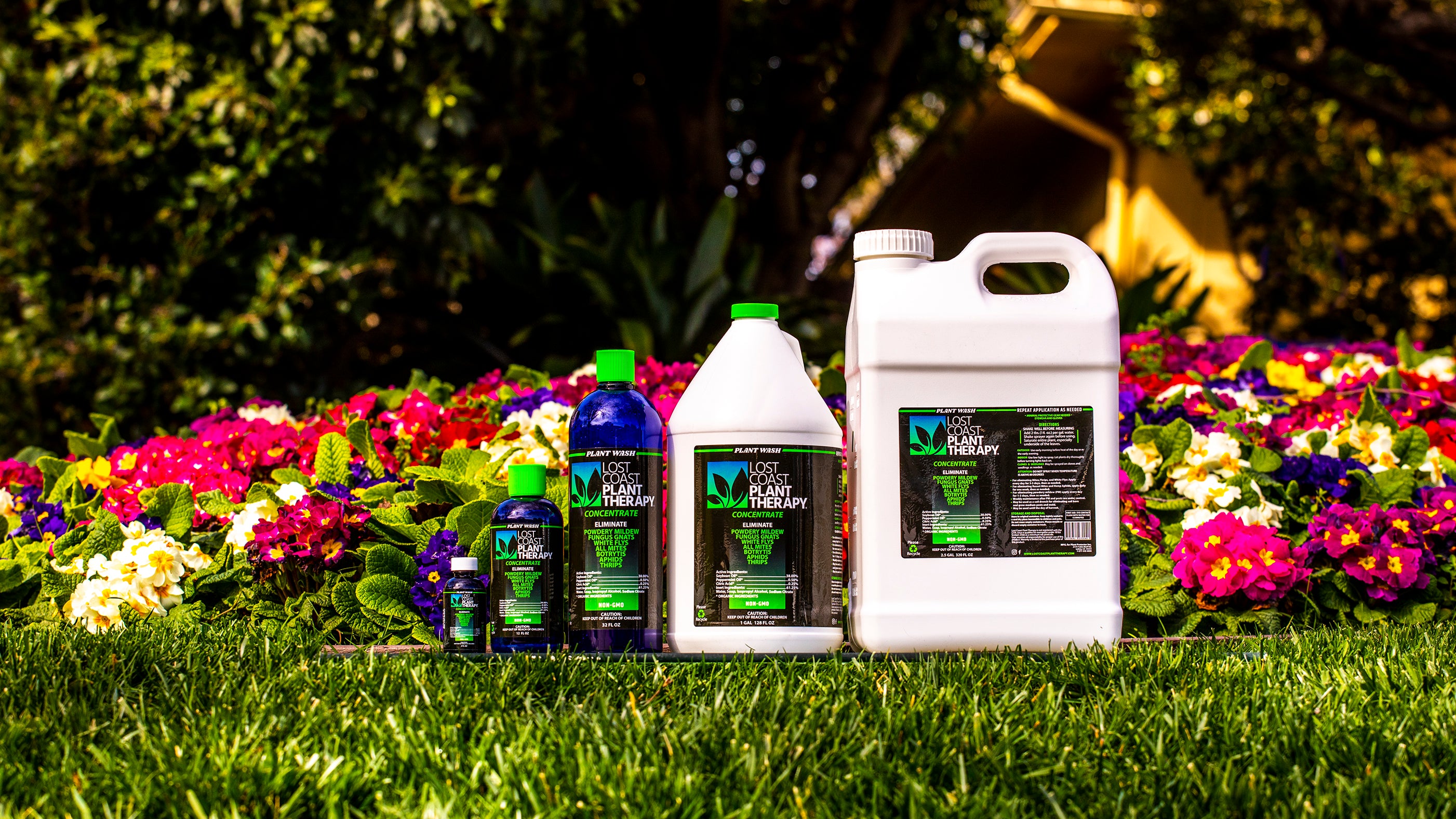
Lost Coast Plant Therapy is our Natural Plant Wash and Natural Plant Protector made with natural and organic ingredients. Once your diagnosis points to active powdery mildew or a supported soft bodied pest, choose the Concentrate size that fits your garden and follow the current label and Instructions page for application.

Lost Coast Plant Therapy
Buy now
→
12 oz
Mixes with water to create 12 gallons of application spray.

Lost Coast Plant Therapy
Buy now
→
32 oz
Mixes with water to create 32 gallons of application spray.

Lost Coast Plant Therapy
Buy now
→
1 Gallon
Mixes with water to create 128 gallons of application spray.

Lost Coast Plant Therapy
Buy now
→
2.5 Gallon
Mixes with water to create 320 gallons of application spray.