
Brush your hand across a tomato plant on a warm afternoon and watch what happens. If a tiny white cloud lifts off the leaves, hovers for a second, and then settles back down, you have whiteflies. These are some of the most frustrating pests a tomato grower can face, partly because they are easy to miss until the population has already exploded, and partly because they almost never go away after a single treatment.
Getting rid of whiteflies on tomatoes is all about timing. The adults you see flying are only a fraction of the problem, because the eggs and the flat, scale-like young are glued to the undersides of the leaves, where one spray rarely reaches them. Even if you beat the visible adults, a fresh batch can hatch a few days later, ready to start over.
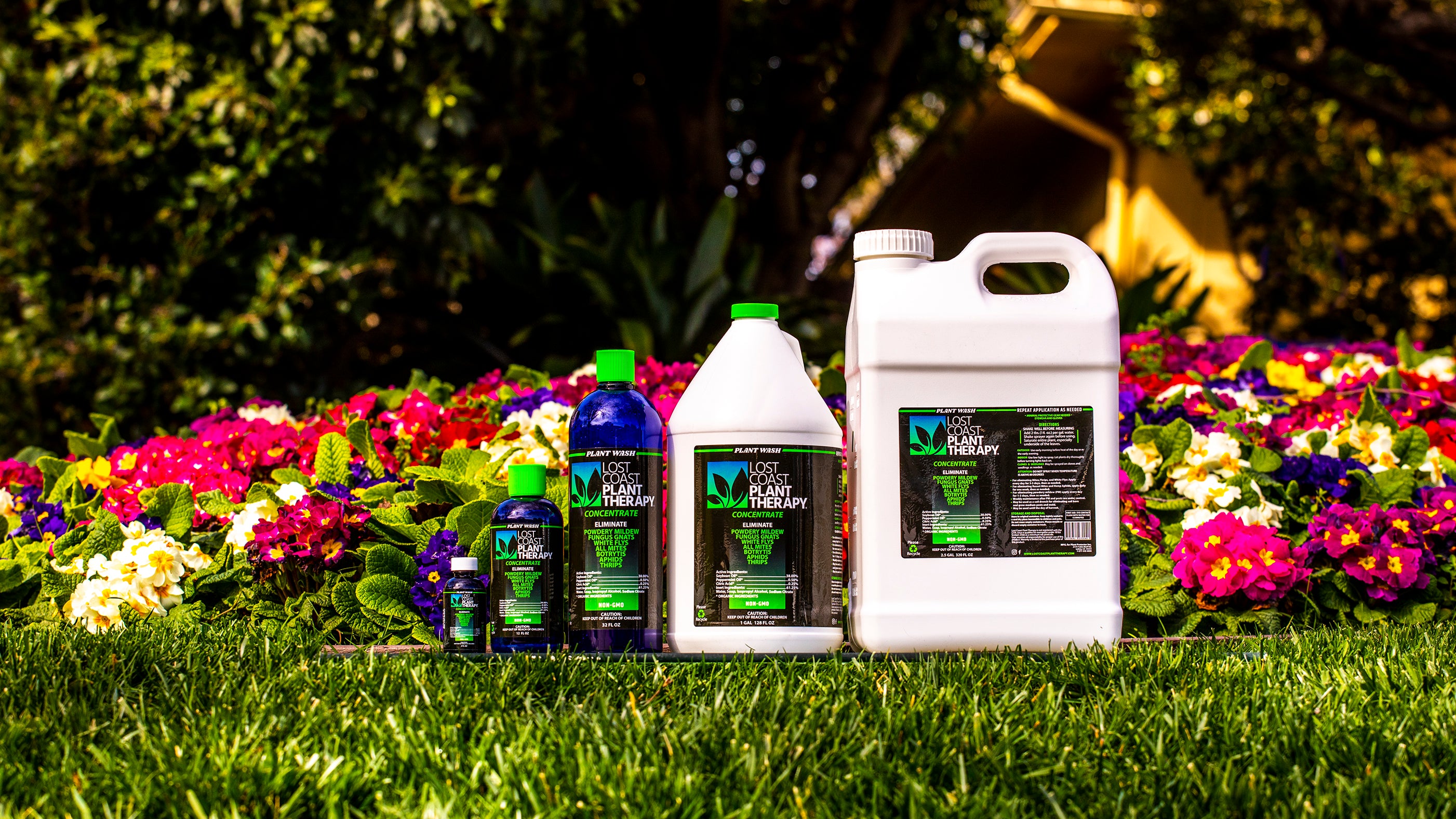
Below you'll see a tomato whitefly treatment schedule that runs week by week, built around the pest's life cycle so you catch each new generation before it can lay the next round of whitefly eggs. Paired with Lost Coast Plant Therapy, a minimum risk pesticide and a 3-in-1 pest control solution, that schedule becomes something you can run confidently around your food, your kids, and your pets.

What Are Whiteflies, and Why Do They Love Tomatoes?
Whiteflies are not actually flies. They are small, sap-sucking insects more closely related to aphids and scale, with soft bodies and powdery white wings about the size of a sesame seed. They have wings and can fly, so when you disturb the plant they lift off the leaves in a swarm before settling again. They gather in clusters on the undersides of leaves, pierce the plant tissue with straw-like mouthparts, and suck the plant juice your tomato plant worked hard to produce.
Tomatoes are a favorite target for a few specific reasons. The plants are soft, leafy, and fast-growing, which gives whiteflies an endless supply of tender tissue to feed on. The canopy is dense, so the bugs stay sheltered and hidden. And tomatoes are usually grown in the warm part of the year, which is exactly when whitefly populations spike. Heat shortens the time it takes for an egg to become an adult, so a manageable handful in June can become a heavy infestation by late July if you do nothing.

Greenhouse Whitefly vs. Silverleaf Whitefly (Bemisia)
Two whitefly species matter most to tomato growers, and they behave differently enough that it is worth learning to tell them apart. There are other species of whiteflies out there, like the giant whitefly that shows up on ornamentals, but these two are the ones that drive most trouble in tomato production.
The greenhouse whitefly (Trialeurodes vaporariorum) is the one most home gardeners meet first. Its wings lie fairly flat against its body and look almost rectangular when viewed from above. As the name suggests, it thrives in the protected, stable warmth of a greenhouse or polytunnel, but it shows up in outdoor gardens too, especially in mild climates.

The silverleaf whitefly, also known as Bemisia (Bemisia tabaci) and sometimes called the sweetpotato whitefly, is smaller, slightly more yellow than other whiteflies, and holds its wings at a steeper, roof-like angle so you can often see a thin gap of leaf between them. Bemisia loves heat even more than the greenhouse whitefly and infestations tend to surge in hot, dry summer conditions.
Why Telling the Two Apart Actually Matters
A greenhouse whitefly infestation is mostly a feeding and honeydew problem, serious but treatable. The silverleaf whitefly is a far more dangerous pest on tomatoes because Bemisia can transmit Tomato Yellow Leaf Curl Virus, one of the most destructive tomato diseases in the world. If your tomatoes are in a hot climate and the whiteflies are small with tented wings, treat the situation with extra urgency.

Why Whiteflies Are So Damaging on Tomato Plants
A few whiteflies on a vigorous tomato plant will not do much. The issue is that they multiply quickly.
Sap Loss and Sticky Honeydew
Every whitefly feeds by tapping into the plant's vascular system and sucking out sap. Multiply that by hundreds or thousands of insects, and your tomato plant is being slowly drained of the energy it needs to set and ripen fruit. Once whiteflies have been feeding for a while, you will often see the way it causes leaves to yellow, weaker new growth, and a plant that simply looks tired.
As they feed, whiteflies excrete the excess sugar as a sticky substance called honeydew. This shiny film coats the leaves and fruit, attracts ants, and sets the stage for the next problem.

Sooty Mold on Tomatoes and Lost Photosynthesis
That honeydew is a perfect food source for a dark fungus called sooty mold. Sooty mold on tomatoes shows up as a black, dusty coating on leaves and stems, and while it does not infect the plant directly, it does something almost as harmful. It blankets the leaf surface and blocks sunlight, which means the leaf can no longer photosynthesize efficiently. A tomato plant that cannot photosynthesize cannot feed itself or its fruit. So the whiteflies weaken the plant by feeding, and then the sooty mold smothers its leaves and continues to debilitate the plant. The two problems compound.

Virus Transmission
For tomato growers, the feeding damage is rarely the worst-case scenario. The real danger is what whiteflies carry. When Bemisia feeds on an infected plant and then moves to a healthy one, it can transmit Tomato Yellow Leaf Curl Virus (TYLCV). Infected plants show upward-curling, cupped leaves, yellow leaf margins, stunted growth, and dropped flowers, and once a plant is infected, there is no cure. It will never produce the harvest you hoped for. This is why it's so important to control whiteflies on tomato plants early.

The Whitefly Life Cycle
To understand why the schedule matters, you have to understand how whiteflies grow, because every stage of their life cycle is designed, almost perfectly, to survive a one-time treatment.
It starts with the whitefly adults, the only stage you can easily see. Disturb the plant and they flutter up in that telltale white cloud, then resettle within seconds. While they are there, the females lay tiny whitefly eggs on the undersides of the leaves, often in neat little circles, tucked where sprays and sunlight struggle to reach. The eggs are pale yellow at first and darken as they mature.

Those eggs hatch into the first nymphal stage, the first instar, often called a crawler. This tiny larva walks a short distance, finds a good feeding spot on the leaf underside, and then does something that makes it incredibly hard to control. It settles down, flattens out, and becomes nearly immobile, almost like a scale insect. For the rest of its development it sits there as a flat, translucent, scale-like bump, feeding quietly and shrugging off treatments that would wipe out a soft, exposed bug.

By spraying once, you'll knock down most of the flying adults and feel like you have won. But the eggs are untouched, and the settled nymphs are protected. Within a few days, those eggs hatch and those nymphs mature into new adults, which immediately begin laying the next round of eggs. The population rebounds, and you are back where you started. The full cycle from egg to adult can run in just a few weeks in warm weather, and faster still in the heat.
That is the whole problem in a sentence, a single spray controls what you can see and misses what you cannot. The goal of treating whiteflies on tomatoes is not just to control today's adults. It is to keep hitting the plant on a schedule, every three to four days, so that each new hatch of crawlers and each freshly emerged adult is caught before it can reproduce.
Learn more about whiteflies here.

How to Spot Whiteflies on Tomato Plants Early
The earlier you catch an infestation, the easier and shorter your treatment schedule will be. Build a quick monitoring habit into your normal garden walk, using these four methods together to find whiteflies before they take hold.
Yellow Sticky Traps
Whiteflies are strongly drawn to the color yellow. Hang a few yellow sticky traps at canopy height among your tomato plants and check them every few days. They act as an early warning system, catching the first scouts before the population is obvious, and they give you a rough sense of whether numbers are climbing or holding steady. In a greenhouse, traps are especially valuable because the enclosed space lets whiteflies build up quickly with no weather to slow them down.

The Shake Test
This one takes two seconds. Give a tomato plant a firm tap or gentle shake and watch the leaves. If a small white cloud of adults flies off the leaves in a swarm and drifts before resettling, you have a breeding population, and the heavier the cloud, the bigger the problem. A plant or two with a light flurry is normal background pressure. A plant that erupts in a thick white haze every time you touch it needs treatment now.

Leaf Underside Inspections
The shake test finds adults, but the eggs and nymphs are the part that decides whether your treatment sticks. Turn over several leaves, especially the lower and inner ones, and look closely at the undersides. You are hunting for tiny pale dots arranged in arcs or clusters on the undersides (the eggs) and small flat, translucent, scale-like specks that do not move (the nymphs). Seeing these on the sides of leaves facing the soil confirms an active, breeding population rather than just a few adults passing through, and it tells you where your spray needs to land.

When Do You Actually Need to Treat?
A useful rule of thumb for home gardeners is if a gentle shake of a plant sends up a visible white cloud, or if you find eggs and settled nymphs on the undersides of more than a few leaves per plant, or if your yellow sticky traps are steadily collecting more whiteflies week over week, it is time to start the treatment schedule. Early, light infestations are far easier to clear than heavy ones, so when in doubt, lean toward starting sooner.

A Minimum Risk Pesticide for Treating Whiteflies on Tomatoes
Because tomatoes are a food crop you handle and eat, the spray you reach for matters as much as how often you use it. Lost Coast Plant Therapy is a FIFRA 25(b) minimum risk pesticide made from food-grade, plant-based ingredients, which means it is gentle enough to spray on vegetable plants you intend to eat and safe to use indoors, in the greenhouse, and around children and pets when used as directed. There is no long re-entry wait, so you can get back to your tomatoes right after spraying.
Its mode of action is contact-based, it coats and suffocates soft-bodied whitefly adults and nymphs right on the leaf where it lands, rather than relying on a systemic poison, so whiteflies do not build resistance to it the way they do to some conventional insecticides. The same spray also helps knock back the sooty mold that follows an infestation.

Adjusting the Schedule for Heat and Greenhouses
Whitefly pressure changes with the weather, so your treatment schedule may need to shift a little depending on where and how your tomatoes are growing. In mild spring weather, the three-to-four-day rhythm is usually a strong starting point. During hot stretches, whiteflies can build momentum faster, so staying on the shorter end of that window becomes more important.
Greenhouse infestations also need extra attention because the environment is so protected. Outdoors, rain, wind, temperature swings, and helpful insects like ladybugs, lacewings, and tiny parasitic wasps all help slow whiteflies down between treatments. In a greenhouse, those natural checks are limited unless you introduce them yourself. The air is warmer and steadier, the plants are sheltered, and the population can keep moving without much interruption.
That does not mean greenhouse tomatoes are harder to save. It simply means you need to be more consistent. Check leaf undersides often, keep yellow sticky traps in place, and stay disciplined with your spray schedule until the pressure drops. When conditions are hot, dry, or protected, timing matters even more than usual.

The Tomato Whitefly Treatment Schedule, Week by Week
The schedule below is designed to interrupt the whitefly life cycle by treating on a timer. Use the timing notes above to decide whether to stay closer to three days or four days between sprays.
A few rules apply to every single treatment:
Spray the undersides of the leaves above all else. This is where the eggs, the nymphs, and most of the feeding happen. A spray that only hits the tops of the leaves treats the wrong surface and misses the part of the population that rebuilds the infestation.
Treat in the early morning or evening, never in the heat of direct midday sun.
Coat thoroughly, like a leaf bath, not a light mist. Whiteflies are contact-vulnerable only where the spray actually lands.
Throughout the schedule, using Lost Coast Plant Therapy as a foliar spray is a great fit for tomatoes, because it works on contact, is gentle on edible crops, and can be applied repeatedly without the residue concerns of harsh synthetics.

Day 1, The First Knockdown
Start by removing the worst of the problem mechanically. Prune off any leaves that are heavily crusted with eggs and nymphs or already blackened with sooty mold, and bag and discard them away from the garden rather than dropping them on the ground. This instantly lowers the population and the egg load you are about to fight.
Then spray. Work from the bottom of the plant upward, turning leaves to drench the undersides, and cover stems and leaf joints too. Your goal on Day 1 is a heavy knockdown of the adults and as many exposed nymphs as you can reach. Be thorough and saturate the plants. You can also hang or refresh your yellow sticky traps at the same time so you have a baseline for tracking progress.

Days 3 to 4, Catching the Next Hatch
Do not wait a full week. By now, eggs that survived Day 1 are hatching into fresh first instar nymphs, and this is your chance to catch them while they are young, before they settle into their armored stage. Spray again with the same thorough, underside-focused coverage. This second pass is the one most people skip, and skipping it is exactly why infestations come roaring back. Treat it as non-negotiable.
Days 7 to 8, Closing Out Week One
Inspect before you spray. Turn over leaves and check whether you are seeing fewer adults in the shake test and fewer fresh eggs on the undersides. Then treat again, prioritizing any hotspots you find. Prune any newly crusted leaves you missed earlier. By the end of week one you have hit the plant three times across the span in which a typical egg batch hatches, which means you have been catching new whiteflies faster than they can mature and reproduce.
Recap Week 1
Day 1: Prune the worst leaves, then spray thoroughly from the bottom up, soaking every leaf underside. Hang yellow sticky traps.
Days 3 to 4: Spray again to catch newly hatched crawlers before they settle into the hard-to-kill nymph stage.
Days 7 to 8: Inspect, then spray a third time and remove any freshly infested leaves.
Why three sprays: a single spray misses the whitefly eggs and nymphs on the undersides. Treating across the whole week catches each new batch before it can mature and reproduce.

Week 2, Continue Spraying
Continue treating every three to four days, so roughly two more applications across the week. The population should be visibly thinner now, but do not stop. Any survivors that reach adulthood will lay eggs and undo your progress, so the point of week two is to keep the pressure constant and grind the breeding cycle to a halt. Keep checking the undersides at each pass and keep removing badly infested leaves.
Do not stop early. Any survivor that reaches adulthood will lay a fresh round of eggs and undo your progress, so the goal of week two is to grind the breeding cycle to a halt.

Week 3, Monitoring and Prevention
By week three, most well-run treatment schedules have broken the back of the infestation. Shift from active spraying toward close monitoring. Do the shake test, scan the leaf undersides, and read your traps. If you are still finding eggs and nymphs, continue the three-to-four-day rhythm for another week. If the plant is coming up clean, you can begin tapering, moving to a single maintenance spray spaced further apart while you keep watching.

Preventing a Rebound
Rebounds happen when a few survivors quietly rebuild while your attention drifts. To prevent them, keep monitoring for at least three to four weeks after your last full treatment, keep a couple of sticky traps in the canopy as an alarm, and stay on top of any weeds or volunteer plants nearby that can harbor whiteflies. If you spot the population creeping back up, restart the three-to-four-day schedule immediately rather than waiting.
Recap Week 3
Shift from active spraying to close monitoring: shake test, underside checks, and trap reads.
Still finding eggs or nymphs? Continue the 3 to 4 day rhythm for another week.
Coming up clean? Taper to a single maintenance spray spaced further apart.
Keep a few sticky traps in the canopy as a permanent early warning system.
Clear nearby weeds and check new transplants.
Prevent rebounds by monitoring for at least 3 to 4 weeks after your last full treatment. If numbers creep back up, restart the schedule right away.

Sometimes the honest answer is that a plant cannot be saved, and recognizing that early protects the rest of your garden. If a tomato plant shows the classic signs of Tomato Yellow Leaf Curl Virus, leaves curling upward and cupping, yellowing margins, severely stunted growth, and flowers dropping without setting fruit, treating the whiteflies will not reverse the disease.
In that situation, the priority shifts from rescue to containment. An infected plant is a reservoir that whiteflies can feed on and then carry the virus to your healthy tomatoes. The smartest move is often to identify and get rid of a badly virus-infected plant rather than nursing it along. The same logic applies to a plant so overwhelmed by feeding damage and sooty mold that it has stopped producing.
Warning: Tomato Yellow Leaf Curl Virus
The silverleaf whitefly, also known as Bemisia, can transmit Tomato Yellow Leaf Curl Virus (TYLCV), which can destroy a tomato crop faster than the feeding damage itself.
Watch for these signs:
- Leaves curling upward and cupping
- Yellowing leaf margins
- Stunted growth
- Flowers dropping without setting fruit
There is no cure once a plant is infected. Treating the whiteflies will not reverse the virus. An infected plant acts as a reservoir, so removing and discarding it is often the best way to protect your remaining healthy tomatoes.

Keeping Whiteflies Off Your Tomatoes for Good
Keeping whiteflies off your tomatoes starts with creating a garden environment that is harder for them to settle into. Give your plants plenty of room to breathe, because crowded tomatoes trap the still, warm air whiteflies love. Early in the season, you can also lay reflective mulch around the base of your plants to help disorient incoming adults and make it harder for them to find the foliage.
A clean, well-tended garden also makes a big difference. Many common weeds can quietly shelter whiteflies between tomato seasons, so regular weeding helps remove those hiding places before the pressure builds. Invite the helpers, too. Ladybugs, lacewings, and tiny parasitic wasps all prey on whiteflies, and a garden that welcomes these natural enemies has a built-in brake on outbreaks.

Before planting anything new, take a moment to inspect transplants carefully, especially the undersides of the leaves where eggs may be tucked out of sight. Once your tomatoes are growing, keep yellow sticky traps in place as a simple early-warning system. Strong tomato pest control is less about reacting to a crisis and more about building steady habits, supporting plant health and noticing the first few whiteflies before they ever become a cloud.

Conclusion
Whiteflies on tomatoes can feel stubborn at first, but they become much less overwhelming once you understand what you are looking for and follow a steady routine. The goal is to stay consistent long enough to interrupt the problem before it keeps rebuilding.
Act early, spray thoroughly, and focus on the undersides of the leaves where whiteflies spend so much of their time. A consistent routine with Lost Coast Plant Therapy, a minimum risk pesticide made with natural and organic ingredients, gives you a practical way to control pests on tomatoes while supporting a garden you can still feel good about harvesting from.
Keep checking your leaves, watching your traps, and trusting what you see. The more familiar you become with your plants, the easier it is to catch problems early and keep your tomatoes growing strong.

Frequently Asked Questions
Why do whiteflies keep coming back after I spray my tomatoes?
Because a single spray can control the adults you can see but miss the whitefly eggs and the flat, scale-like nymphs on the leaf undersides. Those hatch and mature within a few days and start the cycle again. Repeated treatments every three to four days are what break that cycle.
What is the white cloud that flies up when I touch my tomato plant?
Those are adult whiteflies. They have wings and can fly off the leaves in a swarm when disturbed, then resettle within seconds. The shake-the-plant test is one of the quickest ways to confirm an infestation, and the thicker the cloud, the larger the population.
Are whiteflies on tomatoes dangerous, or just annoying?
They can be genuinely dangerous. Beyond draining sap and coating leaves in honeydew and sooty mold, the silverleaf whitefly (Bemisia) can transmit Tomato Yellow Leaf Curl Virus, which permanently damages the plant. The virus risk is usually more serious than the feeding damage itself.

How long does it take to get rid of whiteflies on tomato plants?
Plan for two to three weeks of treating every three to four days, since that is roughly how long it takes to exhaust the eggs and nymphs already on the plant. Lighter, early infestations clear faster, which is why catching them early matters so much.
Do yellow sticky traps actually work for whiteflies?
Yes, as a monitoring tool and a modest control aid. Whiteflies are strongly attracted to yellow, so traps catch scouts early and help you track whether the population is rising or falling. They work best alongside a spray schedule, not as a standalone cure.
What can I spray on tomatoes for whiteflies that is safe to eat?
Choose a minimum risk pesticide made from food-grade ingredients like Lost Coast Plant Therapy. Our 3-in-1 pest control solution works on contact and can be used right up to harvest.

Can I save a tomato plant that already has Tomato Yellow Leaf Curl Virus?
No. There is no cure once a plant is infected. The leaves will stay curled and yellow and the plant will not produce a normal harvest. Removing it usually protects your remaining healthy tomatoes from becoming infected.
When is the best time of day to spray tomatoes for whiteflies?
Early morning or evening, never in direct midday heat. Spraying in the cool part of the day protects the foliage from leaf burn and gives the treatment time to work before it evaporates.
See more FAQs here.

Additional Resources
Whiteflies, Pest Notes and Management Guidelines - University of California Statewide IPM Program
Tomato Yellow Leaf Curl, Pest Management Guidelines - University of California Statewide IPM Program
Tomato Yellow Leaf Curl Virus - NC State Extension
Managing Whiteflies on Indoor and Outdoor Plants - University of Missouri Extension
Whiteflies - University of Minnesota Extension
Whiteflies - University of California Agriculture & Natural Resources
Aphids | Life Cycle & Reproduction
Cabbage Aphids - University of Massachusetts Amherst